





Book Tickets Online
About
It is an archaeological complex with a life that would develop, according to the data we know today, between the first and sixth centuries AD. The enclave would revolve around a villa of whose residential area we only know, so far, a few hot springs. This building was accessed by a monumental staircase that preserved remains of wall paintings, and which converged in a distributor, porticoed courtyard (the bases of its twelve columns are preserved) and paved with a polychrome mosaic with geometric motifs.
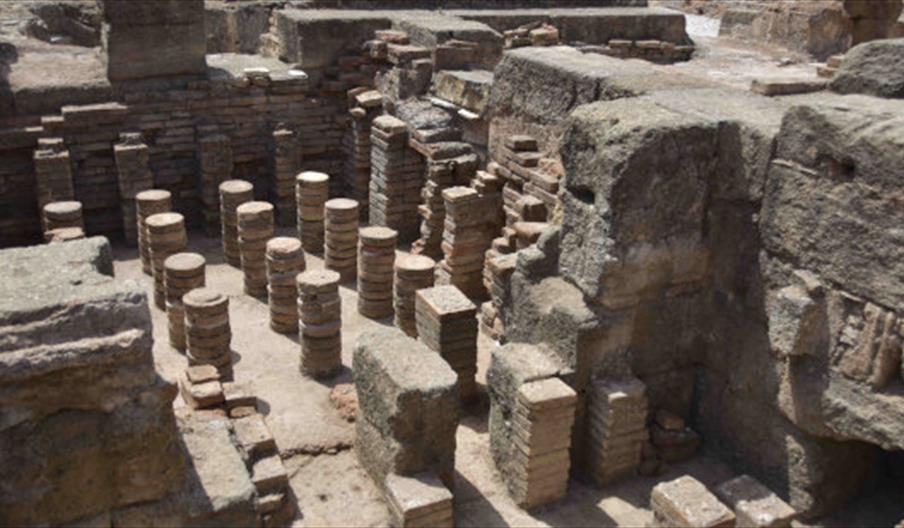
Among its facilities it had two fountains, one of them in the shape of an apse that was decorated with a parietal mosaic delimited by seashells, as well as two pools that in one of the cases were covered with marble while in the other it was covered with opus signinum, next to a possible latrine with a floor of this same material to which a small canal was attached through which the water flowed. The heated area had four rooms, one of which had two bathtubs, as well as having two ovens delimited by walls intended to provide heat to the baths, a set that also had a circular pool with seats at its corners and a water tank from which a pipe started to conduct the water to the thermal complex.
With regard to the industrial part of the enclave, it is worth noting the presence of a pottery made up of five ceramic kilns, four of which, precisely the largest ones, had a chamber that showed a central pillar. Near these ovens were located two areas of landfills and a salting factory composed of a battery of eight basins and two annexed rooms.

Facilities
Beach access
- Easy on foot